
Dental Crowns & Bridges | Oakbrook Terrace, IL
All of your teeth play an important role in speaking, chewing, and maintaining the proper alignment of other teeth. Tooth loss doesn’t necessarily have to occur as you age, but if you do lose teeth, they must be replaced to maintain the proper function of your mouth. Fortunately, there are options for repairing severely damaged teeth and correcting tooth loss. Dental crowns and bridges are two of the most common ways to repair or replace damaged or missing teeth.
Key Benefits of Dental Crowns & Bridges
- Restore or repair severely damaged or vulnerable teeth
- Replace missing teeth
- Offer support to misshapen teeth or badly broken teeth
- Look completely natural
- Fix “smile” and functional chewing problems
- Prevent shifting of remaining natural teeth
- Help support facial contours
What are the Capabilities of Dental Crowns and Bridges?
Many dental problems can be corrected using these techniques. The materials used for these repairs are either high-grade porcelain or porcelain bonded to gold. A higher strength of porcelain and gold materials is recommended for treating the most serious dental problems. Where accidental damage has resulted in lost teeth, or where teeth have broken away through excessive wear or due to old fillings breaking, dental crowns or bridges can be used as a long-term solution.
Many people have unexplained pain from filled back teeth, which is usually due to hairline cracks in the chewing part of the tooth. Placing crowns on these teeth relieves the pain and restores full dental function. In front teeth, older fillings can both weaken the teeth and cause “appearance” problems due to staining or chipping. Porcelain crowns and bridges are suitable in cases where porcelain veneers are not. In teeth with root canal fillings, crowns can prevent breakage.
Restore Your Smile’s Strength and Function
Don't let dental discomfort hold you back. The team at Awesome Dentistry uses modern, durable treatments to repair damaged teeth and return confidence to your bite.
Dental Crown Process
Traditional Crowns
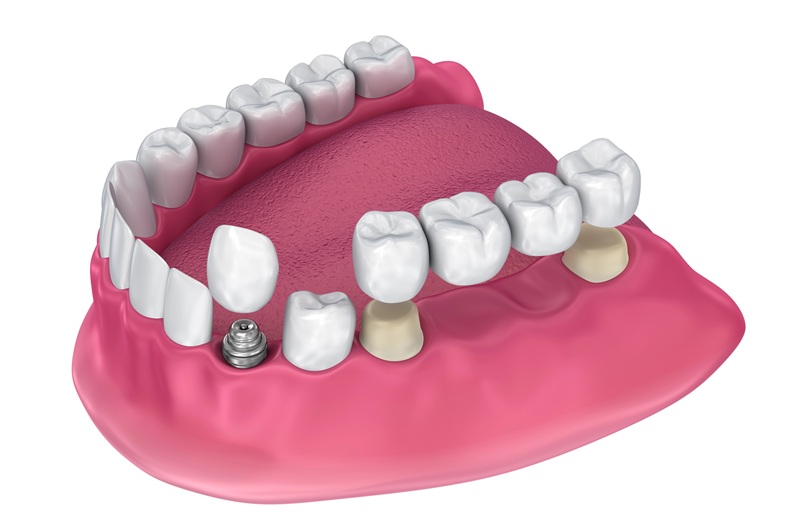 For a traditional dental crown, Drs. Ivanova, Aleman or Kufta first numbs the area, then carefully reshapes the tooth to make space for the crown. They take an impression or digital scan of the prepared tooth and send it to our dental lab, where your custom crown is made. While you wait for your permanent crown, we provide a temporary crown to protect your tooth. When your permanent crown is complete, we remove the temporary and cement the final restoration in place, carefully checking the fit and trimming or smoothing any rough edges.
Same-Day Crowns
Same-day crowns can be made from digital scans using specialized software to design the crown. The design is then sent to our in-house milling machine, which carves the crown from a solid block of ceramic and matches its color to your remaining teeth. Once it’s ready, we bond it to the tooth so you can leave with a permanent restoration that day, without a temporary crown or a second visit.
Dental Bridge Process
There are two types of dental bridges available, depending on your individual needs and the number of teeth missing. Fixed bridges and removable bridges are both excellent options for replacing two or more missing teeth.
Fixed Bridge
Drs. Ivanova, Aleman or Kufta begins by taking impressions of the mouth and sending them to our dental lab. The artificial teeth are created and fused between two crowns at either end. We then attach the fixed bridge in place over the gap where teeth are missing by bonding the crowns to the natural teeth on either side. This type of bridge can only be removed by a dentist. The process typically requires two or three appointments.
Removable Bridge (Partial Denture)
A removable bridge, sometimes called a partial denture, is designed differently. Instead of being cemented in, it clips onto nearby teeth with small metal or plastic attachments, allowing you to remove it for cleaning and sleeping. It is a more flexible and affordable option, especially for people who may not be ready for a fixed bridge or dental implants. As with a fixed bridge, a removable bridge usually requires more than one appointment.
